
In the last seven months, Los Angeles has cut the ribbons on an astonishing number of high-profile museum projects: a blob-shaped building at the Los Angeles County Museum of Art, the new Lucas Museum of Narrative Art, and this week, a 200,000-square-foot expansion at the California Science Center that harbors the space shuttle Endeavour in launch position.
Over this same period, a free art space has been quietly taking shape on the city’s fringes. When it opens to the public on Sunday, the Alta, as it is known, will fill a void; the Los Angeles area will finally gain a major Chicano cultural center. The Cheech Marin Center for Chicano Art & Culture debuted to much acclaim in 2022, but The Cheech is more than an hour away, in Riverside.
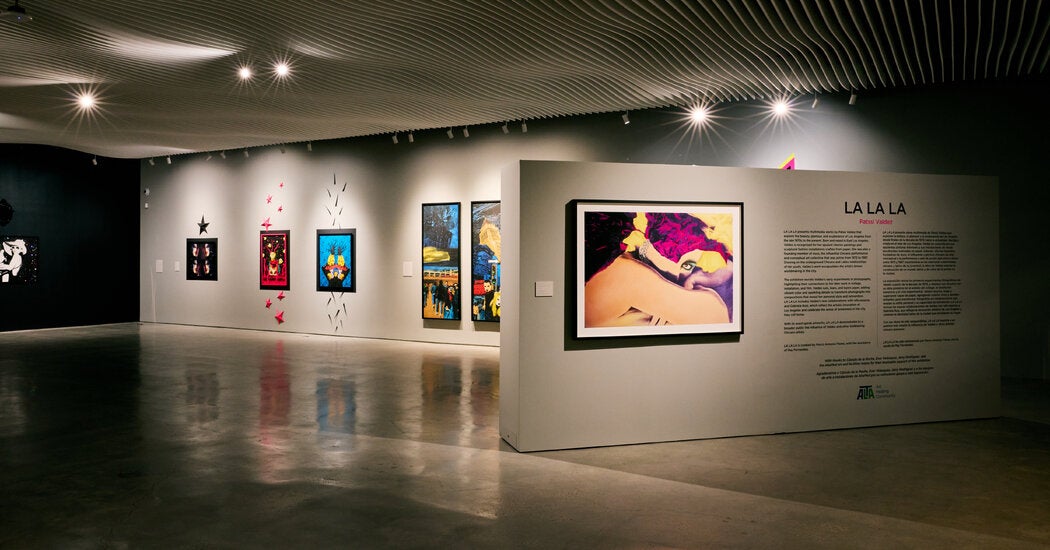
Just 10 miles east of downtown, the Alta holds work from the AltaMed Health Services collection, the nation’s largest corporate collection of Chicano, Latino and Mexican art. It inhabits a squat warehouse next to a Tesla dealership in Montebello (an independent city contiguous to East Los Angeles). Behind its blank facades, you’ll find a pair of artist residency spaces, a visible storage room and a 3,200-square-foot gallery featuring rotating exhibitions. Currently on view is “LA LA LA,” centered on the photography of Patssi Valdez, who is perhaps best known as a co-founder of the influential art collective Asco.
Since the Alta’s soft opening in May, a small stream of visitors has arrived to see the art by appointment, but otherwise it has remained under the radar. During my visit, Pilar Tompkins Rivas, AltaMed’s chief curator and vice president for art, joked that the space has had the vibe of a speakeasy.
That will not be the case for much longer. Valdez, who grew up in East Los Angeles in the 1970s and ’80s, says the center is a boon for this historically Mexican American district. “When I was in East L.A. and Montebello, we would always head west,” she said. “There wasn’t anything here. So, this is a big deal.”
The opening marks a full circle of sorts, since many of the artists whose work is held at the Alta, along with AltaMed’s network of community clinics, hail from the east side of Los Angeles. The center will offer a place to examine a corner of art history that remains underexplored.
“It’s thinking about the artists that have been important to the collection over time and how we want to showcase that,” Tompkins Rivas says of the Alta’s mission. “The collection here is also in service to the patient community. So, how can we develop exhibitions and programs so that it’s not just about art for art’s sake, but about care and compassion for the community?”
“Wellness” and “care” are words that come up a lot at the Alta. The center’s inaugural artists in residence, Rubén Esparza and Felicia Montes, both explore topics related to health in their work: Esparza has created multimedia pieces around H.I.V./AIDS, and Montes is director of Mujeres de Maiz, an art and wellness organization rooted in Indigenous knowledge.
AltaMed is not the first health organization to steward a notable art collection. The Cleveland Clinic has a collection of more than 7,000 works and a gallery space that puts on temporary shows. Likewise, Cedars-Sinai, on the west side of Los Angeles, holds more than 4,000 pieces of art, including a light installation by Robert Irwin and outdoor umbrellas designed by John Baldessari.
The AltaMed collection, however, is unique in its focus on Chicano art (though many other cultures also figure in the collection). It also stands apart for the ways it connects to the Chicano civil rights movement of the 1960s and ’70s.
The company began life as the East L.A. Free Clinic in 1969. Founded by the Brown Berets, a Chicano group akin to the Black Panthers, its aim was to provide free health care to uninsured inhabitants of the neighborhood. Like any cash-strapped organization running largely on gumption, its first decade was bumpy. The clinic — a pair of examination rooms stocked with secondhand equipment — cycled through management teams and locations, evolving first into the El Barrio Free Clinic and, later, La Clínica Familiar del Barrio.
In 1977, Cástulo de la Rocha, a Mexican immigrant who grew up in neighboring Boyle Heights, joined the staff as an administrator. He was supposed to stay for three months but ended up spending his entire career there, helping grow that single clinic into AltaMed, the largest federally qualified health center in California. (The company accepts federal funds to care for patients who may not have the ability to pay.) The company now operates a network of more than 60 clinics across Los Angeles and Orange County. To this day, de la Rocha serves as the organization’s president.
From the company’s earliest days, art was part of the equation — and the collection remains infused with the spirit of the Chicano civil rights movement. This reflects de la Rocha’s background, too: He was a student activist as an undergraduate at the University of California, Santa Barbara, in the late 1960s and early ’70s, and later worked at a Latino legal aid center in the Bay Area while completing his law degree at the University of California, Berkeley. That was a time when Chicano art and activism walked hand in hand.
“Silk-screens were our social media,” he explained during an interview a dozen miles south of the Alta at a Norwalk AltaMed, where an incandescent mural of a lake by Margaret Garcia graces the center’s community room. “Vietnam, farmworkers, protests — anything we organized — there were posters.” As an undergraduate, he and his classmates put together “El Plan de Santa Bárbara,” a 154-page manifesto that tackled issues of representation and outlined a Chicano studies curriculum. Featured throughout the proposal was work by Chicano artists, including a cover illustration by the muralist and printmaker Malaquías Montoya (who is represented in AltaMed’s collection).
For de la Rocha, placing art in clinics was an extension of that activist practice and a way to immerse clientele in art that had been made in and for the Latino community. “I wanted to show on the clinic walls what renacimiento meant,” he said, using the Spanish word for renaissance. “Reclaiming our history, fighting for social justice, equality — that was so real to me.”
AltaMed now has some 4,000 artworks in a range of formats, more than half of which will be held at the Alta. Currently on display in the visible storage room is an arresting triptych by the painter Frank Romero inspired by the turn-of-the-16th century “Unicorn Tapestries” on display at the Met Cloisters in New York. Like the original, Romero’s painting shows a unicorn in a corral; in his version, however, the creature is surrounded by armed men. It is titled “El Salvador” and was painted during the Salvadoran civil war.
The core of AltaMed’s holdings are prints — the most practical form of work to display in a clinical setting. This includes suites created at local studios, such as Self Help Graphics & Art, a Latino art space that also came to life in East Los Angeles in the 1970s, and Modern Multiples, the downtown atelier that was run by the Chicano master printer Richard Duardo (who died in 2014). Tompkins Rivas sees it as “a feedback loop,” in which AltaMed helps support local artists whose work can then be seen locally within the clinics — and now the new exhibition space.
The Alta is not the only artistic endeavor that AltaMed has in the works. The company recently signed a lease on a two-acre parcel in downtown Los Angeles to create a temporary art park — a move that has not been without controversy among area residents, since it turns public land over to private use. (It will be funded by a separate nonprofit established specifically for this purpose.)
For now, however, the focus remains on Montebello. The collection contains works by lesser known Mexican American artists who predate the Chicano civil rights movement, like the painter Roberto Chavez, a mordant observer of the human condition who first emerged in the 1950s and was connected to the idiosyncratic Ceeje Gallery on the edge of West Hollywood.
The art history of that era is still being written. And the Alta, along with AltaMed’s dozens of clinics, offers a distinctive place to tell the story. “We can reach 700,000 people through their annual visits to the clinics; that rivals attendance for some museums,” says Tompkins Rivas. “It also becomes part of what people are experiencing in their daily lives. You’re not seeking it out, but you’re encountering it — in an environment where you’re being cared for.”
The Alta
1401 North Montebello Blvd., Montebello, Calif.; altamedart.org/thealta.